Using mantras in Sahaja Yoga

When most of us hear the word mantra, we picture monks of long ago chanting in stone monasteries.
In a culture shaped by AirPods, playlists, and on-demand noise, chanting can feel like a throwback. Something ancient. Maybe even a little strange.
And yet, the use of repeated words or sounds to quiet the mind isn’t new, and it isn’t limited to one tradition. Long before meditation apps and curated soundtracks, human beings discovered that sound could help the heart become quiet.
Mantras in Sahaja Yoga
In Sanskrit—the language from which yoga evolved—the root man means “to meditate,” and tra means “instrument of.” A mantra is understood as an instrument for meditation: a sound used to help attention settle.
In Sahaja Yoga, mantras are considered sacred sounds that work on the subtle system—the inner system that becomes perceptible after self-realization. They are not used mechanically, with endless repetition, or as something to concentrate on intensely. They’re offered quietly, with attention, as a way of supporting the energy centers inside of us to make it easier for the brain to be quiet.
One of the most widely known examples of a mantra is Aum (often written Om). It’s understood as the sound through which creation unfolds. For Christians, this isn’t entirely foreign. The Book of Genesis tells of God speaking the world into being. Sound, in this sense, is the creative force.
And of course from the Book of John:
In the beginning was the Word (logos), and the Word was with God, and the Word was God.
He was with God in the beginning.
Through him all things were made; without him nothing was made that has been made.
In him was life, and that life was the light of all mankind.
In Sahaja Yoga, you can think of mantras like a tuning aid that helps bring the system back into balance.
Why are the names of deities used as mantras?
This is the place where I deeply misunderstood.
Hearing the name of a goddess used in a chant in a group meditation unsettled me. It triggered every internal alarm I had. I remember thinking, Have I accidentally joined a cult?
Here’s what I missed.
I grew up knowing very little about how people growing up in other geographies honored God. In fact, my understanding of God was shaped almost entirely within a certain geographic brand of Christianity.
I remember a Brahmin once explaining to me that there isn’t, in fact, a Hindu pantheon in the way Westerners often imagine it. There is one God. One source. What appears as many is understood as different expressions of the same divine reality.
Christians already hold this pattern.
We affirm one God, and yet we speak of Father, Son, and Holy Spirit. Distinct expressions, not separate gods. We’re comfortable holding mystery here, even if we don’t fully understand it.
A wider story than the one I was taught
There’s also an idea in Sahaja Yoga that God reaches humanity across time and geography—not once, not in one place, but again and again, in ways people can understand.
I knew the names that were familiar to me: Abraham. Moses. Jesus. Mary.
I had at least heard of Mohammad, Buddha, and Lao Tzu.
But Ganesha, Saraswati, Lakshmi, and Guru Nanak were foreign to me.
At first, their unfamiliarity felt threatening. Over time, it began to feel humbling as I asked questions in my heart.
What if God’s desire to reach human beings is bigger than the story I inherited?
What if “for God so loved the world” was broader than I had ever imagined?
What if when Jesus said things like, “I have other sheep that are not of this sheep pen. I must bring them also. They too will listen to my voice, and there shall be one flock and one shepherd. (Gospel of John 10:16) He was talking about people who would call Him by other names?
Getting back to mantra…
In Sahaja Yoga, names aren’t presented as rivals to the God I worship, rather they’re used to point attention toward specific qualities—love, joy, peace, kindness—that Christians already recognize as fruits of the Spirit.
For me, the work hasn’t been deciding what to believe about every name. It’s been learning how to sit with what’s unfamiliar without fear, and to notice where my attention is actually directed.
That distinction continues to guide me.
Mantras associated with different chakras
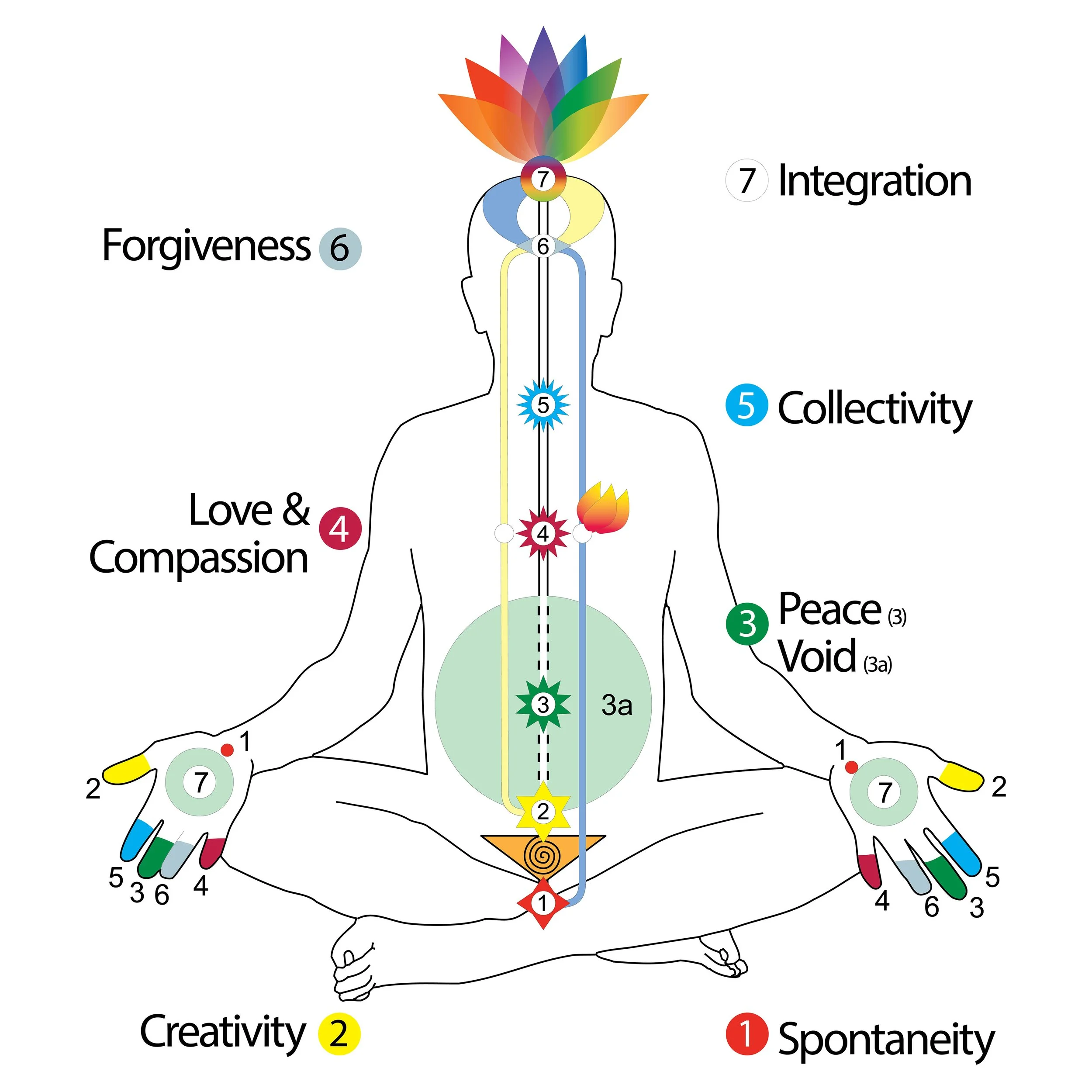
Sahaja Yoga Chakra Chart
This chart shows how Sahaja Yoga describes the subtle system—the inner system experienced after self-realization—and the qualities associated with each chakra.
The basics of the system:
Three channels: left, right, and center.
Seven chakras (energy centers)
The kundalini* energy (located in the sacrum bone)
The chakras map onto the hands. It’s common to experience tingling, itching, or warmth when there is an imbalance in a chakra and the kundalini is clearing it during meditation.
*Note: In Sahaja Yoga, the kundalini energy is a mothering, loving, energy that is inside every person. It is not an outside force. The most similar Christian idea is Imago Dei—the image of God that we were born with.
In Sahaja Yoga, these names are used to describe divine qualities associated with different aspects of the subtle system.
| Chakras & Channels | Location | Core qualities | Mantras traditionally associated (Sahaja Yoga) |
|---|---|---|---|
| 1st Mooladhara | Base of spine | Innocence, joy, wisdom | Shri Ganesha |
| 2nd Swadisthana | Lower abdomen | Creativity, attention, pure knowledge | Shri Brahmadeva, Shri Saraswati |
| 3rd Nabhi | Navel area | Peace, generosity, balance | Shri Vishnu, Shri Lakshmi |
| Void (Bhavasagara) | Surrounding Nabhi | Seeking, righteousness, guidance | Adi Guru: Raja Janaka, Abraham, Moses, Zoroaster, Lao Tse, Confucius, Socrates, Prophet Mohammed, Guru Nanak, Shirdi Sai Baba |
| 4th Anahata | Heart | Love, security, courage | Shri Shiva, Shri Jagadamba, Shri Rama, Shri Sita |
| 5th Vishuddhi | Throat | Communication, collectivity, kindness | Shri Krishna, Shri Radha |
| 6th Agnya | Forehead | Forgiveness, humility, surrender | Shri Jesus Christ, Shri Mary, The Lord's Prayer |
| 7th Sahasrara | Top of head | Integration, realization, union with the Divine | Shri Mataji Nirmala Devi |
| Ida Nadi | Left side | Channel of desire | Shri St. Michael, Shri Mahakali |
| Pingala Nadi | Right side | Channel of action | Shri St. Gabriel, Shri Hanumana |
| Shushumna Nadi | Center spine | Channel of action | Shri Mahalakshmi |
How to say the Sanskrit mantra
Om twam eva sakshat.
[Shri Jesus Mary] sakshat.
Shri Adi Shakti Mataji.
Shri Nirmala Devi, namo namaha.
English translation
Truly, you are in front of my eyes
The living presence of Holy Jesus and Mary.
Holy Spirit. Mother.
Holy Pure Divine. I bow in reverence.
You may notice in the chart above that Shri Mataji Nirmala Devi is associated with the seventh chakra, the Sahasrara. Shri Mataji stated explicitly that her purpose was to open this center collectively so that self-realization could be experienced directly by people around the world. In Sahaja Yoga, the Sahasrara represents the point where the individual's subtle system connects with the all-pervading power of God’s love, and inner awareness becomes steady and complete.
This teaching is not presented as something to be accepted as any kind of doctrine. As Shri Mataji emphasized repeatedly, it is meant to be understood through experience. Discernment and conscience remain essential parts of engaging with it.
Do I have to use mantras?
You can also use affirmations to clear and balance the chakras. These affirmations reflect the qualities of each center and are phrased intentionally: “I am” on the left side to help release conditioning from the past, and “Mother, please” on the center and right sides to keep the attention free from ego. There’s nothing formal about the words, and you will often hear different variations, but they address the qualities of each chakra and channel.
| Left | Center | Right |
|---|---|---|
|
Mooladhara I am the powerful innocence of a child. |
Mother, please make me innocent and wise. |
Mother, the Divine is the destroyer of all negativity. |
|
Swadhisthana I am the pure knowledge of the Divine. |
Mother, please give me pure creativity. |
Mother, please give me pure attention and pure action. |
|
Nabhi I am satisfied, peaceful, and generous. |
Mother, please give me spiritual evolution. |
Mother, please make me balanced and righteous. |
|
Void I am my own master. |
Mother, please awaken the Guru Principle in me. |
Mother, please give me the self-discipline of a true master. |
|
Heart I am fearless and confident. |
Mother, I am the Spirit. |
Mother, please awaken the sense of responsibility in me. |
|
Vishuddhi I am not guilty. |
Mother, please make me a collective person. |
Mother, please give me sweetness in my words and actions. |
|
Agnya I forgive everyone. |
Mother, please forgive me. |
Mother, I forgive myself. |
|
Sahasrara Mother, thank You for giving me my Self-Realization. |
Please establish my connection with the Divine. |
Mother, by Your Grace, I am protected. |
Mantras in Sahaja Yoga are offered, not imposed. How—and whether—a Christian uses them is a matter of personal discernment.
I once heard a talk where Shri Mataji Nirmala Devi explained that people naturally feel closest to the aspect of the divine they already recognize—Christians to Christ, Hindus to Ganesha—because awareness is already awakened there.
Personally, in my current understanding, if there is only one God, then there is harmony between Christ and Ganesha. But I didn’t always see it that way. It may be that the only mantra you ever use is the name of Jesus, and that is beautiful, complete, and enough.